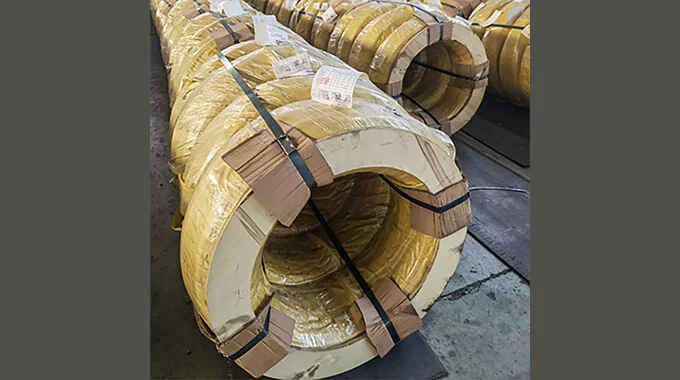
Technical data for 22 MnB4 cold-drawn steel wire, compliant with EN 10263-3. View the chemical composition, mechanical properties, and related technical requirements for this grade.
Only data directly related to this material is shown here. Inspection, equipment, process and packaging information is linked separately.
1. Combinations of delivery conditions
Table 1 – Combinations of delivery conditions, product forms, and conformity requirements
Table 2 – Surface quality under delivery conditions
Surface condition upon delivery
Symbol
Bar
Rolled wire
Wire
unless otherwise agreed
hot-rolled
none or +AR
X —
X —
—
Special surface condition delivered by agreement
cold-drawn
+C
— X
— -
X
after-drawn
+LC
— X
— X
X
peeledElements
+PE
X
X
X
2. Chemical composition
Table 3 – Steel grades and chemical composition. Cast analysis, mass fraction %
Table 4 – Permissible limit deviations for the applicable limits of workpiece analysis and melt analysis in Table 3
Elements
Limit values according to melt analysis, mass fraction in %
Limits for product analysis, mass fraction in %a
C
≤0,24
±0.02
Si
≤0,30
±0,03
Mn
≤1,00
±0,04
>1,00 ≤1,40
±0,06
P
≤0,025
+0,005
S
≤0,040
+0,005
Cr
≤1,70
±0,05
Mo
≤0.30
±0.0.3
>0.30 ≤0,50
±0,04
Ni
≤1,00
±0,03
>1,00 ≤1,70
±0,05
B
≤0,005(
±0,0003
Cu
≤0.25
+0.03
a ± means that, for a given melt, either the upper or the lower limit of the range specified for melt analysis in Table 3 may be exceeded, but not both simultaneously. b For steels with a defined sulfur range (0,020 %to 0,040 %according to melt analysis), the tolerance is ±0.005 %.
3. Mechanical properties
Table 6 - Mechanical properties of boron alloy steels
4. Hardenability requirements
Table 8 – Hardness limits for steel grades with normal hardenability requirements (H grade, see 6.4.1)
TECHNICAL NOTE
Application and ordering note
Chemical composition, mechanical properties, tolerances and delivery condition must be confirmed against the applicable standard edition, customer drawing and order specification.